| 
Central
Electron Microscopy Facilities
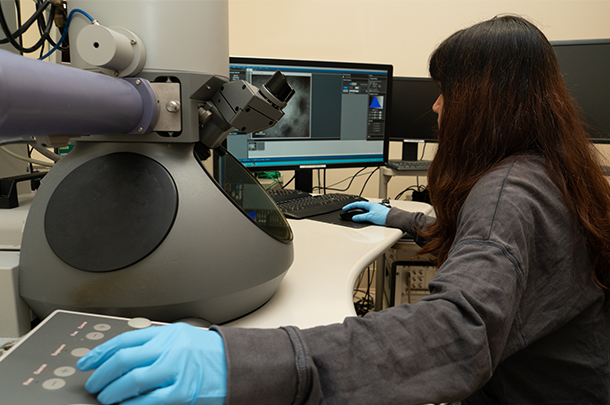
The Central Electron Microscopy
Facility is housed on the first floor of
Roberts Hall in the Earl and Mary Roberts
Characterization Facility. This facility
is open to all research groups within the
university for characterization by Electron
Microscopy. The facility staff will provide assistance
and training in electron microscopy techniques
to enable research groups to achieve their
research objectives. The Central Electron
Microscopy Facility features seven operating
electron microscopes, four Transmission Electron
Microscopes and two Scanning Electron Microscopes
and one Focus Ion Bean Scanning Microscope.
Of the four Transmission Electron Microscopes,
the latest addition to the facility is the FEI
Tecnai F20 Field Emission Transmission Electron
Microscope with a point resolution of 0.23 nm
and Scanning Transmission Electron capability
with a resolution of 0.2 nm. The Tecnai F20 is
equipped with the Gatan Imaging Filter and Energy
Dispersive Xray, and all of the imaging and spectroscopy
software are interfaced with the microscope central
computer. The F20 microscope is also equipped
with a Lorentz lens for magnetic imaging using
Fersnel and Fouccault modes.
The JEOL 4000EX is a High Resolution Transmission
Electron Microscope having an accelerating
voltage of 400 kv, with point a resolution 0.17
nm. It is equipped with a Gatan Imaging Filter.
The JEOL 2000EX Transmission Electron Microscope
has a resolution 0.24 nm and two Gatan Imaging
System. This microscope is also configured
for in situ specimen heating and cooling. The
Philips CM12 is a Transmission Electron Microscope
and Scanning Transmission Electron Microscope,
equipped with Energy Dispersive Xray and a Gatan
CCD camera. The microscope is configured with
texture analysis using automated crystallography
for Transmission Electron Microscopes.
There are two Scanning Electron Microscopes:
The
Philips XL-30 Field Emission
Microscope has a resolution of 2 nm. The microscope is
equipped with Energy Dispersive Xray, Wavelength
Dispersive Xray and EBIC. The system is fully
quantitative, with Xray imaging and quantitative
Xray imaging.
The Philips XL-40 Field
Emission Scanning Electron Microscope features a dedicated
Orientation Imaging System. NovaLab
600 Dual Beam, Focus Ion Beam and
Field Emission Scanning Electron
Microscope, with latest Orientation Imaging
system and Autoprobe Lift-Out tool.
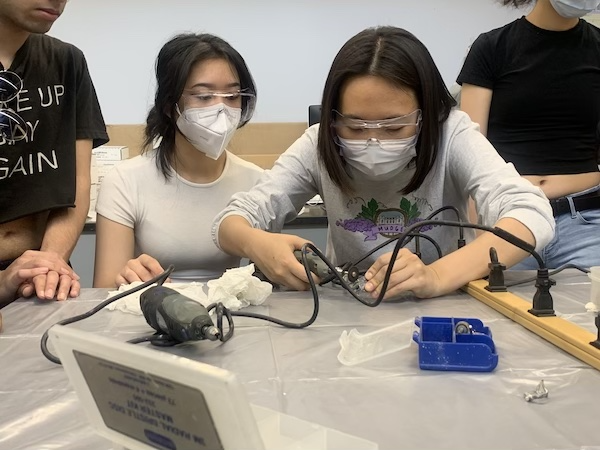
The Central Electron Microscopy Facility
includes a complete specimen preparation
facility for transmission and surface specimen
preparation. Supporting the specimen preparation
for transmission electron microscopy are
three Gatan Precision Ion Polishing machines,
four dimpling machines, and an electro-polishing
system. Surface preparation for scanning electron
microscopy includes high vacuum sputter coating
and ion etching equipment.
Coming in 2008: the FEI Titian 300-80 High Resolution
TEM/STEM.
top
X-Ray
Equipment
A wide variety of x-ray diffraction measurements
are obtained from three Rigaku x-ray generators.
The accessories available with these machines
enable pole figure texture analysis, thin film
analysis, high and low temperature studies, stress
measurements, and x-ray topography. A Philips
high resolution diffractometer produces fine rocking
curves and reciprocal space maps for epitaxial
films and single crystals. Two Siemens x-ray generators
provide Laue photography and Seeman-Bohlin geometry.
Enhancing the above equipment is a powerful array
of crystallographic software.
Fluorescence, fluoroscopy, and radiography facilities
are also available.
X-ray
lab Home Page
top
Light
Optical Devices
The following instruments are maintained in an
easily accessible centralized laboratory along
with auxiliary cutting and polishing equipment:
measuring microscopes made by Leitz, Eeichert,
and OptoMetrica; a Wild 420 low magnification
optical microscope; a Zeiss Ultraphot microscope
equipped with Nomarski phase contrast lens; a
Zeiss double beam interferometer for surface studies;
two Bausch and Lomb Research Metallographs and
a Reichert Ultrastar-Met metallograph with CCD
and image analysis system. Complimenting these
devices are various low power lasers and optical
benches.
A scanning laser confocal microscope equipped
with a hot stage capable of reaching 1700 C is
a recent addition to our facilities.
top
Mechanical
Testing Devices
Servo-hydraulic Material Testing Systems (MTS)
machines facilitate the study of fatigue and fracture
toughness. Within the department are three MTS
810 instruments with 10, 20, and 50 kip load frames
and two MTS 880 instruments with 10 and 20 kip
frames. The 880 models are capable of computer
interfacing for complete automated testing. Two
Thermal Technology, Inc. vacuum furnaces enable
high temperature fatigue testing.
Two impact testing machines exist in the department.
A Sonntag Universal impact tester handles ordinary
Charpy tests. It is equipped with dual impact
heads for multiple force ranges. A Dynatup impact
apparatus is used for instrumented Charpy testing.
Seven Satec testing machines accommodate stress
rupture (creep) testing. An additional Applied
Test Systems creep frame is equipped with an Oxy-Gon
inert gas/vacuum chamber.
Tension
and compression testing takes place on two electro-mechanical
Instron machines. 10 kip and 20 kip load frames
are available with ancillary devices for high
and low temperature testing.
Standard Rockwell hardness testing is performed
on two Wilson instruments. A Zwick and an additional
Wilson instrument provide micro-hardness testing.
Finally, a biaxial sheet formability testing
system is available. This unique device can be
used to impose both tension-tension and tension-compression
strain states on flat sheet samples.
top
Heat
Treating, Melting, and Pressure Treating Devices
Facilities for basic heat treatment operations
include numerous tube, box, and drop furnaces
of various sizes. Manufacturers include Lindberg,
Lucifer, Thermalyne, and Varian. The furnaces
are fitted for certain modes of heat treatment
operation such as salt baths and inert gas atmospheres.
Each furnace utilizes electronic temperature control
and some are capable of achieving 1700ÁC.
Exotic melting experiments are performed with
various high power RF induction generators which
include an Ameritherm 20kW induction furnace,
an Inductotherm 75 kW furnace, and a GCA 15 kW
vacuum induction melter. A Consarc 150 kW vacuum
induction "skull" melting and casting
unit is available to study the casting of reactive
materials.
Basic high pressure treatments are made on an
assortment of departmental hydraulic presses and
rolling mills. More elaborate treatments use an
Autoclave Engineers 60,000 psi isostatic press.
Still more involved are: a hot triaxial press
system for deformation processing studies to 60,000
psi at 1200ÁC, and an Electrofuel Corp.
hot press providing 10 tons of pressure at 2300ÁC.
top
Electronic
and Magnetic Measurement Devices
Various electronic characterization tools exist
within individual project laboratories. Some noteworthy
items are: a Hall effect system for measuring
carrier concentration, mobility, and resistivity;
a BioRad Deep Level Transient Spectrometer (DLTS)
for examining capacitance transients; and a Walker
high frequency permeameter for AC permeability
measurements. A cryostat accessory can be mounted
on the Hall system and the DLTS for measurements
in a 4ÁK-400ÁK temperature range.
The following magnetic characterization instruments
are contained in one project laboratory. A Super
conducting QUantum Interference Device (SQUID)
manufactured by Quantum Design is equipped with
a 5.5 Tesla Sample Property Measurement System
(SPMS) for DC magnetization measurements. A 9
Tesla Physical Property Measurement System (PPMS)
also by Quantum Design measures AC magnetization
and resistance. Both the SPMS and the PPMS allow
measurements in a 4ÁK-400ÁK range.
Two Vibrating Sample Magnetometers (VSMÍs)
permit measuring of magnetization versus field,
time, or temperature (up to 1000ÁC). These
are a Lakeshore 7300 VSM with a Varian 2 Tesla
electromagnet and an EG&G VSM 155 using a ±1
Tesla electromagnet with bipolar power supply.
To measure Curie temperatures, a Thermal Magnetization
Analyzer (TMA also known as a Faraday balance)
was constructed in house using a 0.5 Tesla Walker
magnet.
top
Spectrophotometers
and Chemical Analyzers
An assortment of chemical analysis equipment
utilized within individual project laboratories
include: a Leco carbon and sulfur gas analyzer,
a Leco oxygen analyzer, and a Hewlet-Packard gas
chromatograph; a Perkin-Elmer model 4000 atomic
absorption spectrometer and a Dycor Electronics
quadrupole mass spectrometer; a Galaxy 5000 FTIR
equipped with CsI optics for far infra-red work.
top
Thermal
Measurement Devices
Equipment available for detecting thermal reactions
and phase changes include: a Perkin-Elmer Differential
Scanning Calorimeter (DSC) with sub-ambient cooling
accessory and a TA Instruments model 2910 DSC
with a range from ambient to 1500ÁC; a
Thermal Gravimetric Analyzer (TGA) equipped with
a Cahn D-100 micro-balance (range: ambient to
1600ÁC); a Perkin-Elmer Differential Thermal
Analyzer (DTA); and a new TA instruments SDT 2960
simultaneous DTA-TGA with controlled atmosphere
and 1500Á range. An Orton Corp. high temperature
(1600ÁC) dilatometer for thermal expansion
measurements is also available.
top
Sample
Preparation
Several groups within the department have specialized
methods for producing thin films. Three major
systems grow epitaxial semiconductor films. One
is an integrated liquid phase epitaxy system.
A Thomas Swan OrganoMetallic Vapor Phase Epitaxial
system (OMVPE) is dedicated to nitrides. A silicon
carbide sublimation growth furnace utilizing the
modified Lely method is currently being installed.
Two methods are supported for making films from
colloids and solutions. These are a Specialty
Coating Systems spin coater, and a spray deposition
system built in house. In addition to these film
systems are a variety of sputtering chambers and
vacuum evaporators including a Balzers Model UMS
50o Dual gun E-Beam Vacuum evaporator with vacuum
interlock chambers and motorized sample manipulators.
Sputtering equipment is also avaiblable in a campus
clean room maintained outside the department.
Some of our specialized powder synthesis entails:
a TEKNA RF plasma torch for creating refractory
carbides and metal nanoparticles, a carbon arc
reactor for making carbon coated nanoparticles,
and Yamato spray drying equipment.
Equipment is provided for growing large single
crystals of NaCl or various metals. Metallic glasses
may also be investigated through the use of an
induction heated melt spinner.
Ancillary equipment to facilitate particular
sample preparation techniques include: Southbay
crystal orientation and cutting equipment, an
Elox Electric Discharge Machine (EDM) for stress
free cutting, a Struers-Abramin automated sample
polishing apparatus, electropolishers and jet
thinners, and two Vacuum Atmospheres Corp. glove
boxes.
top
Computer
Equipment
In addition to the outstanding campus computer
clusters, Materials Science personnel have 24
hour access to two departmental clusters. One
is a general use facility containing an assortment
of Macintosh, Windows, and Unix machines. A cluster
of five DEC Alpha workstations serves more powerful
computing needs. Beyond these units are eight
other DEC Alphas, three Silicon Graphics, and
some 150 PC's and Macintoshes spread throughout
the department. All have access to the campus
network, the internet, and a Novell server for
internal communication and backup requirements.
MSE information and faculty home pages may be
found at the department's
web site.
top
Miscellaneous
Various surface investigation equipment includes:
a Dektak surface profile measuring system, a Quantachrome
Nova-1000 gas sorption analyzer for surface area
and porosity measurements, and a spin
top |